
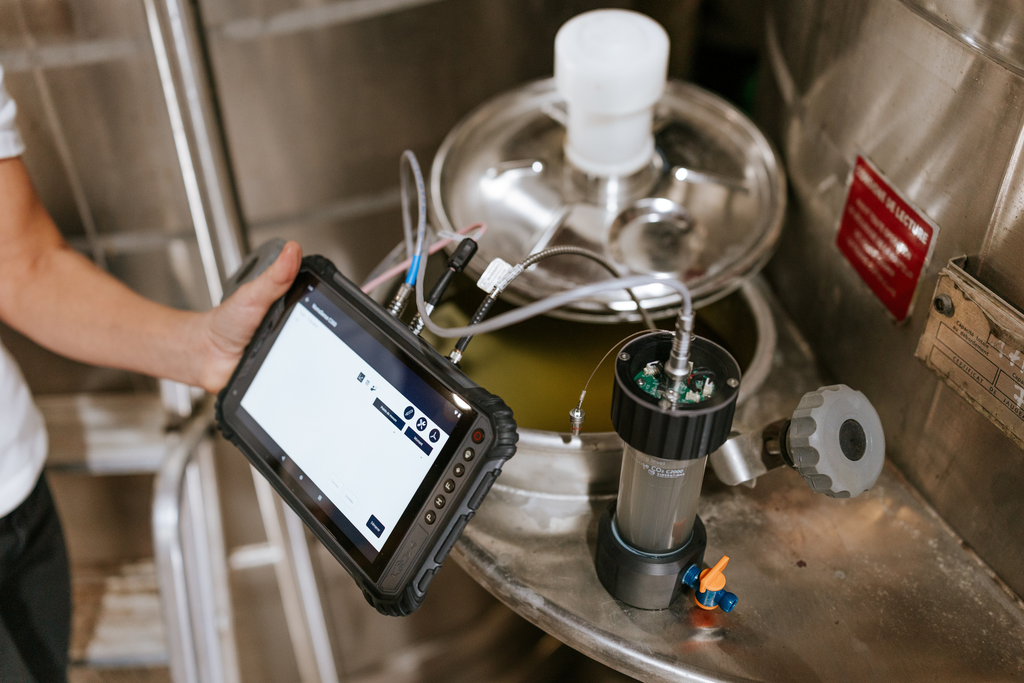
For many years, Vinventions teams have been conducting bottling audits and R&D work on packaging gases. Here are the benchmarks to know and the critical points to watch to control O₂ and CO₂ from tank to bottle.
Oxygen: aim for low, consistent TPO
Oxygen picked up during packaging governs how the wine evolves in the bottle: loss of aromatic freshness, consumption of free SO₂ (on average, 1 mg/L of oxygen consumes 2.4 mg/L of free SO₂), color evolution. The goal is twofold: limit the amount of oxygen picked up, and also its variation from one bottle to the next, which creates inconsistency within a single lot.
The key indicator is TPO (Total Package Oxygen), the sum of the oxygen dissolved in the wine and the gaseous oxygen in the headspace. Measuring dissolved oxygen alone is not enough: according to the Nomasense O₂ database, the headspace accounts on average for about half of the oxygen picked up at bottling, and this is where variability is highest.
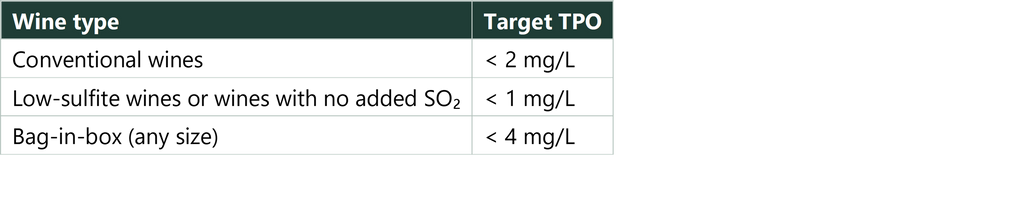
TPO targets
Putting procedures in place does not guarantee results. Analysis of the Nomasense O₂ database (measurements taken between 2022 and 2024 by more than 40 wineries and bottlers in six countries) confirms it: 50% of bottles with cylindrical closures reach a TPO below 2 mg/L, compared with fewer than a quarter of bag-in-box packages and no screw-cap bottles. Upstream, only 30% of tanks show less than 0.5 mg/L of dissolved oxygen before packaging, and more than half exceed 1 mg/L. We recommend aiming for less than 0.8 mg/L, ideally less than 0.5 mg/L. For the lines, the goal is to reach less than 2% oxygen before filling, which often requires a few extra minutes of inert gas injection.
Dissolved CO₂: adjust, then preserve
In still wines, dissolved CO₂ shapes the taste balance. It generally enhances freshness and acidity, softens the perception of sweetness and, in red wines, can heighten bitterness and astringency. It can also amplify direct aromatic intensity. Depending on the matrix, a 200 mg/L difference in the same wine can be enough to produce two different sensory profiles.
At bottling, still wines generally contain between 300 and 1,500 mg/L of CO₂. The target concentration is set according to the wine’s profile and the desired style; it is adjusted before bottling, then must be maintained all the way to the bottle.
Adjust precisely. CO₂ dissolves more readily at low temperature: an increase is best carried out on wine below 10 °C (50 °F), nitrogen degassing preferably between 15 and 20 °C (59–68 °F). In both cases, the operation only makes sense if it is checked by reliable measurement. The widely used carbodoseur offers limited precision (±150 mg/L), on the same order as perceptible differences. Laboratory analysis gives an after-the-fact result, and transporting the sample (temperature, shaking, delay) can bias the measured value.
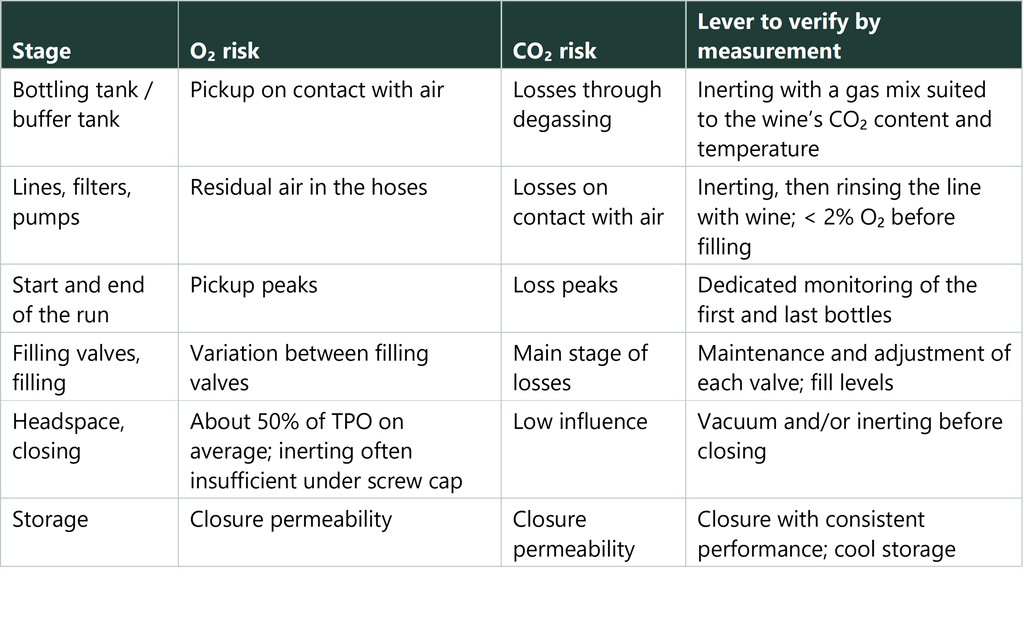
Preserve during the bottling run. Filling is the stage where most CO₂ escapes, especially at the start and end of the run. The lines and the buffer tank must be inerted with a gas mix containing CO₂: nitrogen alone protects against oxygen but strips out part of the dissolved CO₂. The proportion depends on the wine’s CO₂ content and temperature. For example, for a white wine at 1,000 mg/L:

Preserve in the bottle. Closures are permeable to CO₂ as well as to oxygen. A closure with consistent performance limits differences between bottles of the same lot. Storage below 15 °C (59 °F) limits losses more than storage above 20 °C (68 °F).
O₂ and CO₂: two distinct gases, the same critical points
O₂ and CO₂ are two independent parameters, managed in parallel: controlling one does not guarantee control of the other. Yet oxygen pickup and CO₂ loss occur at the same stages of bottling, and the same practice can act differently on each. Inerting with nitrogen alone, for example, protects the wine from oxygen but causes it to lose part of its dissolved CO₂.
Our solutions to measure O₂ and CO₂ at the same point
Measuring O₂ and CO₂ at the same point confirms that your practices protect the wine from oxidation without stripping its freshness.
Nomasense O₂ C300 — measurement of dissolved oxygen and headspace oxygen, to calculate TPO and track its variations in tank, in the lines, after filters or pumps, and in the bottle.
Nomasense CO₂ C2000 — measurement of dissolved CO₂ directly in the cellar, in tank, in bottle or in bag-in-box, on fixed and mobile lines:
- precision ±50 mg/L, over a range of 0 to 2,500 mg/L;
- result in under a minute;
- original manometric method with triple correction (differential pressure, atmospheric pressure, temperature), with no pump or moving parts;
- temperature range of 0 °C to 40 °C; white, rosé and red wines.
A common platform, scalable use. Both devices share the same tablet: O₂ and CO₂ are managed on a single screen, and every measurement is saved in the Enology Portal (history, industry benchmark, exports). The Nomasense CO₂ C2000 can be purchased alone and later complemented by the Nomasense O₂ C300, or added to an existing Nomasense O₂ C300.
Use cases at bottling: adjusting CO₂ content before bottling, identifying the stages of CO₂ loss and O₂ pickup, validating line inerting efficiency, checks at the start, middle and end of the run.
Key takeaways
- O₂: aim for a TPO < 2 mg/L (< 1 mg/L for low- or no-sulfite wines) and, above all, consistent from one bottle to the next.
- CO₂: set a target suited to the wine’s style, adjust it with precise measurement, then maintain it all the way to the bottle.
- Inerting: use a gas mix containing CO₂, adjusted to the wine’s CO₂ content and temperature.
- Critical points: start and end of the run, filling valves, headspace, choice of closure.
- Measurement: check O₂ and CO₂ at the same point, at every stage where an action is taken.

